lale aran etiketine sahip kayıtlar gösteriliyor. Tüm kayıtları göster

27 Şubat 2015 Cuma

Whose flower is tulip?

Spring is fast approaching and I am anxiously waiting for the tulips to bloom.

For about two decades now, city municipality in Istanbul is dedicated to turn Istanbul into a large tulip garden. Starting in mid March till about end of June we see parade of different kinds of tulips, all shapes and colors cheerfully color the streets, parks, public areas.

Visitors seeing these tulips immediately say, "tulips from Holland". That moment, my heart sinks and as a guide as start telling the story, after all it is my job. Origin of tulips and the Turks are the same, Central Asia. As Turks immigrated to Asia Minor from the 10th century on, they carried their beloved tulip bulbs with them, planting it in their new homeland. It was not only known as the Turkish flower, but also the holy flower due to it's name. The original name for tulip in Turkish, lale, comes from Persian (Turks went thru what was Persia on their way from Central Asia to Asia Minor), and it is called "laleh". In Arabic "laleh" and Allah are written with exactly same letters making the flower the holy one. This is why in traditional decoration of mosques, it has been the most popular figure.


Tulips in miniature painting and on tiles of the Rustem Paşa Mosque in Istanbul


The first tulipomania of the world was under the Ottomans in Istanbul in the 16th century, during the reign of Suleiman the Magnificent. Tulips became the symbol for power and wealth becoming a status symbol. The flower even gave it's name to the period considered to be the zenith of Ottoman wealth, the Tulip Era. The rare bulbs costed fortunes. The Ottomans had strict laws to regulate cultivation and trade of bulbs, they were not permitted to be taken our of the country.


Emirgan Park, north of the city center is the main destination during spring for tulips.


According to the commonly accepted story, a Flemish scientist growing plants for medicinal purposes got a hold of tulip bulbs thru a European ambassador in the Ottoman court and took it to Holland. The story continues saying that this scientist was so selfish that he did not want to share or sell his bulbs and eventually his garden was raided and flowers finally were freed and spread. Weather this was true or not remains unknown, but we know that tulip bulbs started appearing in Europe and giving way to a frenzy soon. Bulbs were so valuable that they were even used as an exchange medium in trade.


The Yellow Pavilion in Emirgan Park, one of the Ottoman mansions serving as a restaurant. Skyscrapers behind the park mark Istanbul's financial district.


After the decline of Ottomans started, growing tulips became last of their worries and this wonderful flower was forgotten in Turkey. Meanwhile, the Dutch were creating miracles in preserving and growing it and cleverly making a huge industry out of it!

My interest in tulips is not because the season is approaching, but because it is also my name in Turkish, Lale. Tulips grow best in areas that are cold in the winter and higher elevation, such as their homeland, the Central Asia. 
I hope this will be noticed by greater number of people soon so we can get to see tulips across central Turkey, which is cold in winter with higher elevation.


Emirgan Park is the place for newly engaged and wed as a photo op. This photo shows a newly engaged couple, she is wearing a typical dress popularly worn by more conservatives nowadays, hence her hair is covered.


It is delightful to enjoy tulips in Istanbul. Best tulip watching can be done in the historic Emirgan Park north of the city, along the Bosphorus. It is one of the largest public parks of the city with over 100 acres and there are jogging tracks, playgrounds and historical Ottoman mansions serving as cafes and restaurants. Emirgan park is a small scale arboretum, it has over 120 species.

26 Şubat 2015 Perşembe

What is Rick Steves guides doing?

Dear Reader,

Slower winter months give all of us, guides, a chance to focus on meetings, plans and professional training. Rick Steves annually holds a reunion for tour members, and workshops for guides in January.

Turklish guides in Seattle


During the past January, more than 120 of us from different countries in Europe gathered in Edmonds, WA to celebrate and evaluate the past season and be prepared for the upcoming one. For about two intense weeks we participated in meetings in which we handled different aspects of our work. We also got together with our tour members during reunion parties spread over to two days. Our hard work during the day was awarded at the evening, there were social events almost all nights including a big party at Rick’s house.


Training session

Lale (me) and Rick at radio interview

The big event for us was the cultural experience we were provided with. As we introduce our cultures to travelers as we work, Rick Steves staff decided to provide us with a similar experience. They embellished our visit with a cultural activity, a chance to observe the “tailgating”. On that particular day Seattle’s Sea Hawks had a game with Green Bay Packers. Early in the morning yellow school buses pulled in front of the hotel we stayed at to take us to Seattle.
During the drive, our volunteer guides -Rick Steves staff members- provided us with the cultural background and insight for the American football and tail gating. After a drive thru the city and a stop at the Space Needle, we got off the bus in the city center to walk to the stadium for the party and people watching. We were properly prepared with accessories given to us, blue and green bead necklaces!

Bus snack! Donut with Sea Hawks colors.


Our day proved to be a true NW experience as rain started to pour down. Most of us took shelter in coffee shops, crowded the window front seats to watch the Sea Hawks fans not minding the rain to support their team. 

Socializing with locals!

Honestly, the football game didn’t matter much to me, I am not a big soccer fan in Turkey either, but the chance of sharing that festive time with my colleagues and Seattleites was priceless. It was amazing how much the game helped us bond faster with the new guides and new friends we met in Seattle. I am so glad we got to do it. Eventually, I was happy Sea Hawks won, the glory of the day carried joy for the entire following week, during our meetings:) 

Rick Steves guides in Seattle


Inside our school bus.

Of course, thru all of this we learnt about the famous 12th man of Sea Hawks, the supporters. When Sea Hawks people learnt who we were and what we were doing in Edmonds, they gave some 12th man flags to be passed on to guides so we could take them beyond the borders and share photos! After we returned to Turkey, we posed with the flag in Cappadocia, on the Bosphorus and Ephesus. We still have the flag and we will keep taking the 12th man flag to tours with us. Enjoy the 12th man photos below, I exercise my guiding skills explaining the locations of photos1.

From now, knowing the value and meaning, I will be on the watch out for similar chances to share with American travelers in Turkey.

Happy Travels to all,

Lale


You see two continents in this photo. Our guides are next to Bosphorus. On the background there is the Bosphorus Bridge and a late Ottoman period mosque. They are all in Europe. The land across the water is the Asian continent. 


12th man in front of the Hagia Sophia Cathedral in Istanbul. This structure is from the 6th century and was the ONLY grand cathedral for about 1000 years until the Reneissance in Europe. Today, it is one of the most popular sights in Istanbul and serves as a museum.


 12th man in Ephesus. At the back is the Roman theatre from 2nd century. It can seat about 25,000 people! St. Paul wanted to peach Christianity from this theatre, he couldn't and had to run away, thus he ended writing "Letters to Ephesians".


12th man hanging onto the basket of a hot air balloon in Cappadocia!


3 Aralık 2014 Çarşamba

Can we be warm and cozy in Istanbul without Russia?

Dear Reader,

Putin has gone with the wind thru Turkey! Below is a summary of this visit I have compiled from national and international press. 

In spite of significantly different and clashing policies in Syrian crisis, Russian President Vladimir Putin visited Turkey at the beginning of the week. During this visit, President Putin and Erdogan cut a new deal for Turkey to buy additional natural gas from Russia and in return received a 6% discount. 

Presidents Putin and Erdoğan


This is where the question raises, Turkey already buys nearly 55 - 60% of the gas consumed within the country from Russia. Important cities, like Istanbul and Ankara mainly depend on this gas to spend a warm winter. There are objections to this both within Turkey and internationally. Main opposition in Turkey claims that this dependency weakens Turkey's position and directly benefits Russia. In order to accommodate the increased gas flow to Turkey, a new pipeline is planned to be built under the Black Sea. This is of particular importance to Russia as EU has been dragging it's feet to approve of a Russian gas pipeline project to Southern Europe thru Bulgaria after the disputes over Ukraine.
With this new deal with Turkey, Russia plans to bypass EU obstacle and still sell gas to Europe thru Turkey. This explains why Russia offered Turkey to build a gas storage near the Greek border! This hardly guarantees that Europe will buy gas from Russia as Europe does not want to put all eggs in one basket and be dependent to Russia in gas. Turkey is undertaking these risks in hope of becoming an energy hub in the area.

A boiler which can be found in most homes in Istanbul. Leading brands of the national market are German Buderus and Vaillant.

Remembering the facts that the Russians will build Turkey's first nuclear power plant and Turkey imports approximately 30% of coal from Russia, eyebrows raise in concern.

Some national papers in Turkey preferred to focus on the discount that Turkey will get out of this deal instead of portraying the larger picture. 

Economic interests seem to sweep the international political positions to a side. Trade volume between Turkey is Russia's second largest after Germany. Which looks like an attempt to justify deals with Russia, in their joint conference with President Putin, President Erdogan said, "we agree a solution is needed, but we differ on the means." referring the Syrian crisis.

Thank you for reading.

December 02, 2014 Tuesday - Potbelly Hill, Göbeklitepe, Turnpoint in History of Mankind

Dear Reader,

My colleagues on tour indicate that they are impressed by Turkey's rich history and diversity. 

It impresses me too!


Alacahöyük, near Hattushash, capital city of ancient Hittite Kingdom.
Ishakpaşa Palace near Mt. Ararat in east Turkey. 


Lycian sarcophagus, Kas on the Mediterranean.


Beehive Houses in Urfa, south Turkey.
Sumela Monastery, north Turkey, near the Black Sea. 


Many historical facts have changed since I started guiding in late 1980's with new archaeological discoveries. While it is a challenge to keep up professionally, it is also a very exciting ride in an interactive time machine.

These give me a chance to mention Göbeklitepe, the Potbelly Hill, located in southern Turkey in ancient Fertile Crescent. 


Göbeklitepe, areal view.


Göbeklitepe is the earliest monumental structure mankind ever built. Professor of Anthropology at Stanford University and Director of Çatalhöyük Archaeological Project, Ian Hodder, summarized the importance of the site as, "Göbeklitepe changes everything".  

Predating Stonehenge by 6,000 years and Great Pyramid of Giza by 7,000 years, Göbeklitepe from the 9th and 10th millenium BC urges us to reconsider the written history. Dating to the end of the ice age, to a time we thought mankind were hunters and gatherers. 

A very recent discovery comparatively, Göbeklitepe was discovered in 1994 and has been excavated since 1995. Late Professor Klaus Schmidt of German Archaeological Institute lead excavations till his death in 2014. 
The excavations revealed 6 monumental temples out of 20, most consisting of two 5 - 6 meter mega limestone monoliths weighing upto 15 - 20 tons a piece with smaller "T" shaped monoliths circling them. Mainly animal reliefs adorn the monoliths. All carved by the only tool that was available, the flint stone. 


Clearly, such sophisticated structures couldn't have been work of small hunter gatherer communities, but of a well organized civilization who could feed themselves properly. This lead the archaeologists to look around carefully for source of food and they discovered the earliest cultivated wheat. Thus, now Gobeklitepe civilization is recognized as the first to start agriculture. However, it is not very clear if they developed agriculture for sake of being able to build the monumental temples or they built the temples with the fuel / energy they got from consuming cultivated wheat. Regardless, Göbeklitepe people were the first to eat the bread. 


For more information watch the lecture delivered by Professor Klaus Schmidt:


Thank you for reading.

Lale


2 Aralık 2014 Salı

December 01 - Day 8: Konya and Antalya. Sleep in Antalya (2 nights).

We'll begin our day with a tour through Konya, including the busy maze of its sprawling bazaar — a time-tripping treasure trove of hardware, household items, clothing, jewelry, religious paraphernalia and cell phone accessories. Then we'll head over the Taurus Mountains and down to the Mediterranean resort town of Antalya, where we'll take an orientation walk and set you free for dinner on your own. Sleep in Antalya (2 nights). Bus: 6 hrs. Walking: moderate.


Photo by Jamie Blair Gould. Mert's morning bus talk covered the Kurdish situation. Having actively served in Afghanistan as a Turkish Commando, and with a Liberal leaning we felt he gave a very balanced account of the history and the o so relevant situation today on the Turkish border. Reinforcing further my belief in the necessity of travel.


Photo by Jamie Blair Gould. The long, steep descent towards Antalya and the Mediterranean Coast and a vast increase in temperature!


Photo by Jamie Blair Gould. The resort town Antalya and an illuminated Hadrian's Gate one of a number of sites in this coastal town.


1 Aralık 2014 Pazartesi

December 01, 2014 Monday - Pope Franciscus in Turkey

Dear Reader, 

I am Lale, writing from my small study in Istanbul while my colleagues are having a great time discovering Turkey. While I am jealous of the fun and the wonderful energy they are sharing, I am grateful they are here!

With this entry, I want to share some of what is going on currently in Turkey. I hope this will give a context, perspective and insight to the reader.

The big event of the past week was the three day visit of Pope Franciscus, 266th Pope and 8th President of the Vatican State. An army of journalists followed him while he was visiting Ankara and Istanbul. I have compiled information and photos below from international and national media. 


Thousands gathered to see the Pope


In Ankara, Pope Franciscus followed the standard protocol excepted from visiting heads of states. First, he visited the Mausoleum of Ataturk, then met with President Erdogan in his new lavish Presidential Palace. This made him the first official visitor in the palace. After meeting with Turkish President Recep Tayyip Erdogan, the Pope called for dialogue between faiths. The Pope also had made announcements during his flight to Ankara, expressing his gratitude towards the Turkish government for hosting nearly 2,000,000 refugees from Syria. 
President Erdogan presented the Pope with a silver engraved copy of the 15th century declaration for freedom of religion towards Christians in Bosnia (by Ottoman Sultan, Mehmet II).


Pope Franciscus and President Erdoğan


Among all, what made to the local headlines in Ankara was the determination of the Pope for using a modest vehicle, in spite of the fanfare and armoured vehicle prepared for him. 


The Pope in his car


Last Wednesday, before his trip started, Pope himself had announced the upcoming trip saying that he would conduct an Apostolic visit to Turkey, and invited all to say a prayer that his visit triggers a peace and mutual understanding among religions and Turks.
Visit of Pope was timed to correspond with the Feast day of Saint Andrew, brother of St. Peter, founder of the Apostolic Church of Constantinople. Current head of the Apostolic Church of Constantinople is Patriarch Bartholomew, he is considered a successor of Saint Andrew.


Pope Franciscus and Patriarch Bathrolomew


Pope Franciscus attended the Divine Liturgy at the Cathedral, exchanged the kiss of peace with Patriarch Bartholomew, a symbol of reconciliation and love, and the Lord’s Prayer was read by Pope Francis in Latin.


Pope Franciscus and Patriarch Barthomelew


Pope Franciscus also visited the iconic land marks of Istanbul.


The Pope in the Blue Mosque, with muftu of İstanbul


In the Blue Mosque, the Pope with the Muftu of Istanbul on his side, faced Mecca, tied his hands in reflection as a dua was performed by the latter. This very thoughtful gesture is considered a reconciliation between Islam and Christianity, though a Vatican official said the gesture was a silent adoration but not performance of prayer. Same gesture had been performed by Pope Benedictus eight years ago. 


The Pope and Muftu of İstanbul


Pope Franciscus also visited Hagia Sophia, master piece of Byzantine architecture and the oldest standing great Cathedral. Currently a museum today, the building had been the most important Orthodox cathedral for about a thousand years before it was converted and used as a mosque by the Ottomans for five hundred years. 


Pope Franciscus in Hagia Sophia


The Pope in Hagia Sophia


Multi-purpose visit of Pope is also considered a step forward in attempts of reuniting the Catholic and Orthodox Churches which had got separated in 1054. The excommunication was mutually lifted in 1964 in Jerusalem by Patriarch Athenagoras I and Pope Paul VI, hence starting the dialogue that halted for centuries. 
While the Pope addressed the Patriarch as "brother", Patriarch Barthomlemew had attended the inauguration mass of Pope Franciscus in March 2013 in Vatican, a first since 1054. 

The Pope did not neglect touching base with other social leaders and invited some to the Holy Masses held at the Greek Orthodox Catherdal and Saint Spirit Cathedral, he also paid an unplanned visit to the Armenian Patriarch Mesrob Mutafyan who has been hospitalized due to dementia. 

The new week started with another important visit, by President of Russia, Vladimir Putin. Stay tuned...


November 30 - Day 7: Mosque Visit and Mevlâna's Konya. Sleep in Konya (1 night).

This morning we'll travel to the village of Güzelyurt and meet with the local mosque's Imam (counterpart to a minister or rabbi), with an opportunity to ask questions about the Muslim faith and the separation of mosque and state in Turkey. After lunch we'll hit the road and, like Silk Road travelers hundreds of years ago, stop to admire the intricate carvings of a medieval caravanserai (unlimited camel parking). Today's destination is conservative Konya, famous as the 13th-century home of Mevlâna Rumi. We'll tour the poetry-filled Mevlâna Museum, also the site of the mystical philosopher's tomb, a Muslim holy place, before setting you free for dinner on your own. Sleep in Konya (1 night). Bus: 5 hrs. Walking: moderate.


Photo by Jamie Blair Gould. 

Below texts were written by Jamie Blair Gould.
After an evening buffet accompanied by Cappadocian wine, Mert's chosen Raki and Colin's excellent highland malt, the morning started slowly! The stop at country Mosque was the right spiritual move! The Imman, Emir, was not the bearded, cloaked sage the West so readily imagines but a handsome young man in a leather jacket with cell phone in hand. Much more the in the image of the young married Vicar the Church of England is trying to recruit today - compassionate and in touch.


Photos and text by Jamie Blair Gould. Our next stop thrilled me. After years of reading of the fabled 'spice road' and guiding at the Rialto In Venice I was surprised to find an existing Caravanserai - resting station and in good nick! Dating from 1229 it actually housed the great Marco Polo on one of his legendary travels!


Photo by Jamie Blair Gould. Our overnight stop in the conservative town of Konya from the Greek 'Iconia' deriving from Icons was the home of Mevlana Rumi - he of the Whirling Dervishes. This philosophy, we learned, has been recognised as an influential sect of Islam but the poets message was open to all - a spiritual way. We toured the Court House where he presided as Judge, and where the first whirling took place. It is now his Mausoleum and a section adapted as a Mosque - a major shrine for Islam for the great 'inclusive' poet.


Watch Rick Steves video of Western Turkey released in fall 2014 for more insight into Rumi and Whirlling Dervishes:


Here are some more photos taken by our enthusiastic group.

Here are some more photos taken by our enthusiastic group.


Photo by Mark Seymour. 
Beautiful dried fruit and nuts... Great after a ballon trip and a visit to some of the earliest Christian sites in Turkey.


Photo by Mark Seymour.


Photo by Mark Seymour. 
It's dawn and the balloons are up...


Photo by Mark Seymour. Buying nuts and making new friends at the market.


November 29 - Day 6: Countryside Charms

Official plan for the day: Weather permitting, your guide will take interested hikers on a scenic walk through a Cappadocia valley. Non-hikers can spend the morning in Mustafapaşa, or ride with our bus driver to the colorful weekly market in the nearby village of Ürgüp. After lunch, we'll tour the ancient underground city of Kaymaklı — which once included churches, kitchens, metal shops and stables — before returning to our village for an evening on your own.

Entry below and photos are by Mark and Toni Seymour about the hot air balloon ride over the Cappadocian sky. Mark and Toni are from UK and they have been leading Rick Steves tours for a long time. Toni leads France tours and Mark specializes in tours of Great Britain and United Kingdom. Visit Mark's blog: http://afootinbritain.blogspot.fr/ 

At 05:15 am the guides head down to the bus, leaving our warm beds behind us.
This is the big one!

We Rick Steves guides have all been looking forward to our time in Cappadocia, but this day is special. It's a frosty dark morning and there is a sense of expectation filling the bus as we drive up into the hills.

Finally we arrive.

The sun has begun to light up the horizon. We have all finished a light breakfast and driven further up onto the plateaus of Central Turkey. Our miniature convoy of 3 minibuses turn a corner... And there they are, all lined up and partially inflated.

We have arrived at our destination and the guides are filled with awe at the beautiful sight of 3 hot air balloons slowly falling the dawn sky as they await their cargo of passengers.

We are hurried from the minibuses over to our allotted balloons and stand back in admiration at the spectacular age of the gas burners lighting up the dawn.

The moment arrives and we all climb into our basket.


Urgently, our balloon pilot, Mustafa, beckons us to climb in, and we begin our adventure.


The sun begins to club above the horizon at the same moment as we do....
3 balloons, 18 Rick Steve's guides and the sun.
This day was going to be very special.
Mustafa gave my colleagues and I, in balloon number 2, some brief safety instructions as our 'Butterfly' balloon kissed its twin on the way up. Slowly, however, the 3 aircraft began to drift freely over the rugged but intriguing plateau, beneath.


Within minutes we realized that clusters of balloons were rising from all over the region, like love bugs in the summer rising towards the sun.
In my basket, Toni, Nina, Sarah, Mert, Cary, Virginie and Etelke looked at each other with that look that humans share when they experience the unimaginable.... It was amazing!


For the next hour we flew, constantly pointing and chatting excitedly.
But it was peaceful. The sky was clear and we could see Mt. Argeus in the distance. The cave dwellings and villages littered the ground beneath us, and momentarily we saw a white tailed fox dash into one of the rock crevices.


There was so much that could be seen and just too little that could be taken in. Personally, I felt very small and yet very special to be able to enjoy what we all enjoyed together.


The balloon trip ended all too quickly. One hour and 15 minutes in the sky. We had a glass of champagne when we landed and then drove back to our beautiful Cappadocian hotel, just in time to enjoy a second breakfast.
What a great way to start the day!


Following lines were written by Virginie More, about the hot air balloon ride. After having lived ten years between Los Angeles, Montana, and Florida, Virginie has finally settled back in Lyon, France, with her husband Olivier. She is originally from Brittany, one of the chapters she researched for this guidebook. When she is not teaching Americans about her culture while leading Rick Steves' tours, she can be found instructing scuba diving in the Caribbean. 


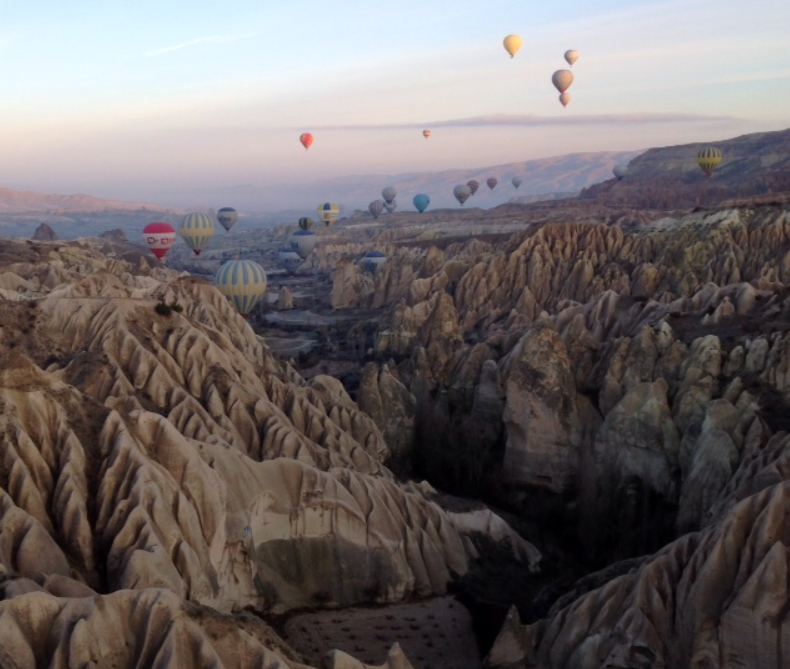
Waking up at 4:30 am can lead to WOW moments! Most of us (18 guides) woke up early for this optional hot air balloon ride over the Cappadocian landscape. For most of us, it was the first time in a balloon. The magical landscape of fairy chimneys, deep gorges, and layered pink and red rocks made this first experience unforgettable, definitely a WOW moment for me! The Butterfly company was very well-organized and professional, those who had some fears about this "flight" were quickly reassured. After an hour in the air and a safe landing, we all toasted our great pilots with bubbles, and we were already talking about our next ballon ride! 

,


Photo by Virgine More. Potpourri of hot air balloons floating over Cappadocia.


Photo by Virgine More. Potpourri of hot air balloons floating over Cappadocia.