6 Aralık 2014 Cumartesi

December 05 - Day 12: Roman City of Ephesus

Official plan of the day: Today we'll tour the ancient city of Ephesus. Famous for its spectacular Temple of Artemis — one of the Seven Wonders of the Ancient World — it was one of the wealthiest cities in Ancient Greece. It also played a role in the formation of the early Christian Church, drawing the attention of the Apostle Paul, and possibly even the Virgin Mary. We'll take an extensive walking tour along the still-paved streets and remarkable ruins of Ephesus, including the dramatically-restored façade of its Library of Celsus. This afternoon you'll have free time to visit Mary's House (where the Virgin Mary may have lived), view more ancient artifacts at the excellent Ephesus Museum in nearby Selçuk, or relax back in Kuşadası. Tonight we'll meet for a final dinner together to share travel memories and toast new friends. Serefe! Bus: 2 hrs. Walking: strenuous.


Aphrodisias, Stadium. One of the finest stadiums left from the Ancient World. Photo by Jamie Blair Gould.

Ephesus, Library of Celcus. Photo by Mark Seymour.

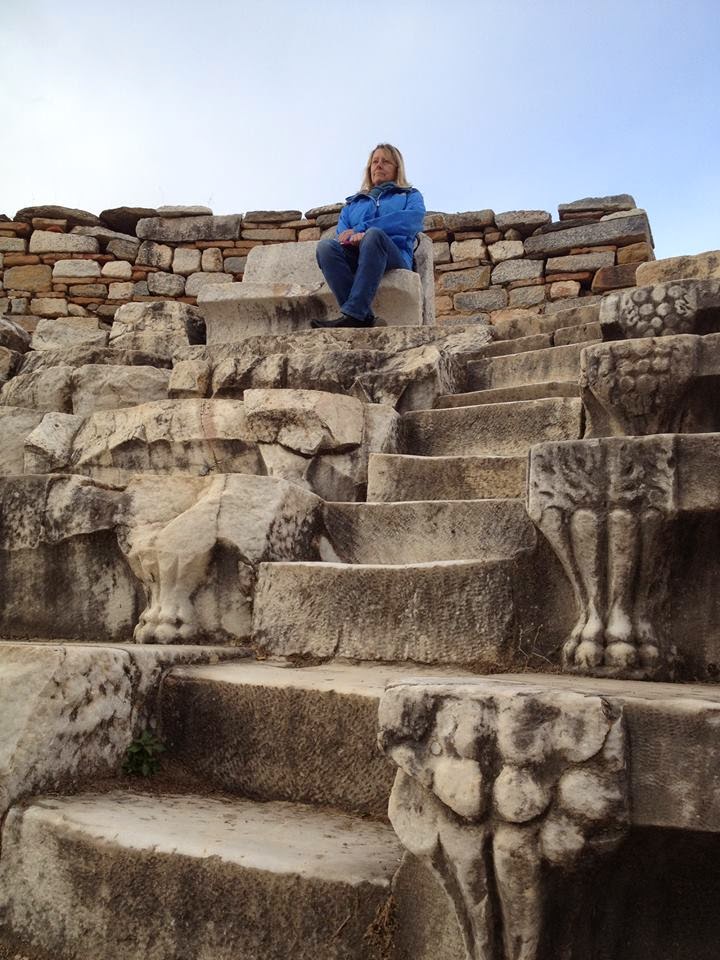
Ephesus theatre. Photo by Mark Seymour.

Mosaics of Terrace House, Ephesus. Photo by Mark Seymour.


What goes on in Turkey?

Syrian Refugees in Turkey

It is the task of any good tour guide to provide a clear “unbiased” look into the country for her (and his) travelers. Therefore, it is among my and my colleagues’ primary goals to help travelers understand the facts as they are, and help them to try to evaluate from the perspective of the locals. As a common practice, during all bus rides on a tour, I gather a collection national and local newspapers that represent different fractions. I read headlines to my travelers, including the different comments of the columnists. And, provide them the opportunity to decide for themselves after looking thru the kaleidoscope.

Imagining the readers of this blog as the extension of the group of Rick Steves’ guides traveling now, I want to share this update about the Syrian refugees with all.

I have been reading different resources and papers, and observing about the Syrian refugees, in sum, I can say we are confused.


“36,000 babies were born in the refugee camps within the past year”, said the Turkish Prime Minister Davudoglu few days ago. Realizing that total number of babies born is about 60,000 in the past three years and almost 2 million Syrian refugees are in Turkey now.


Refugee Camp


Few well to do refugees already established businesses and themselves happily thru Turkey, majority of them being in southeast. Those who are not as lucky take chances, leave camps and seek for job opportunities, or stretch a hand asking for help.

Lately, my Cappadocian friend, a small-scale entrepreneur was penalized for employing refugees as they don’t have work permits. He says, “I don’t have enough money to help them all, but I can employ them.” This is where it gets complicated, we can’t employ them legally, begging is illegal –and looked down upon-, yet they are human beings who need to eat and feed their children.

There are regular campaigns of various NGO’s working had to support the refugees, however number of people needing help is staggering and beyond what local civil attempts can reach. Our heart goes for them.

A report of Amnesty International I read, and Rick Steves’ call for “Share your plate challenge” I watched in his blog lead me to share these with you. According to AI 3.8 million refugees are hosted in five countries, these are: Turkey, Lebanon, Jordan, Iraq, an Egypt. And, only 1.7% of this number was offered shelter by the rest of the world!

AI official noted that Gulf States, Russia and China did not offer any resettlement place.

United Nations World Food Programme (WFP) announced a recent campaign and asks for donating one dollar per person. The official said, “Even one dollar can make a difference. We're saying to people: 'For you, it's a dollar, for them, it's a lifeline.”
You can contribute online directly: www.wfp.org

Yet medallion has another side too, there is a fair resentment among the needy locals and un-employed as refugees seem to have taken their place for receiving the help and sympathy.
The reports about refugee camps are also puzzling. They are said to be the best ever built in Turkey so far with laundry opportunities, schools for the children, career education courses. According to some journalists not all camp dwellers are those who tried to get away from Esad, they came as a better life was promised to them. It is known that refugees in camps are furnished with cash cards that give them a certain allowance for their expenses. If true, why do they leave camps and beg on the streets?!
According to Secretary of Finance, Mr. Mehmet Şimşek, a total of 4.5 billion dollars has been spent for the refugees for the past 3 years as of November 2014. This makes over USD 2,000 per refugee in a basic calculation, considering the number of the refugees sum up to 2 million.

Another fact is the professional beggars disguised as Syrian refugees abusing the good will of hardworking individuals.

We are puzzled.

Thank you for reading.
Lale
PS: I had the privilege to travel to Syria for a number of times in the past, both personally and professionally. My trips included leading tours for American travelers. Now, I am sad seeing the situation of a very hospitable and proud nation, and amazing historic and cultural monuments disappear fast.

All roads lead toÔÇĞ

Some of these monuments and souks don't extist anymore. Photo by Tankut Aran.

Ummayyad Mosque in Damascus is a ruin now. Photo by Tankut Aran.

Me and my husband Tankut with our older son in my tummy, Palmyra ancient city in Syria. Phot by Mary Ann Cameron.

Our group of American travelers in a easy side trip to Baalbek from Syria. Photo by Lale Surrmen Aran.

Baalbek in Lebanon, easy side trip from Syria (at least, back in 2006). Photo by Lale Su¦êrmen Aran.


5 Aralık 2014 Cuma

Below article and photos are by Mark Seymour.

Today we left the coastal city of Antalya and head North. We're all looking forward to our visit to Aphrodisias, but for the men, there is a side trip planned. We are all going to visit a Turkish barber, in a small village, to have a cutthroat shave... I am also going to have a haircut.

After an hours driving, the word goes out that we are almost at our destination..... The anticipation rises !

We blokes have all remained unshaven for a while and I suspect the 'girls' are tired of seeing us look this way. When the bus pulled over, someone cried out 'before and after !'.... We hairy blokes laughed and stood together as a group next to a statue in the village square, as everyone else clicked on their cameras. We posed for a couple of shots and headed into the village.


The girls (who outnumber the blokes by about 4 to 1) intend to go into the village marketplace to explore. We walk quickly into the village and locate the market. As we arrive, there is a call to prayer from the local Imam. He beckons the villagers to trade fairly and to be generous..... The produce looks fantastic !When the prayers finish the unshaven men look at each other... The moment has come. Walking across the street, to the barber shop, I notice that many of the 'girls' have joined us. They are apparently very curious about the process. Our fearless tour leader, Mert, introduces us to the 2 barbers and we are seated. A nervous client looks at us and beats a hasty retreat from the shop.... Sensible ! First man up is Federico..... Will this be a bloodbath ?.


Below Photographs ara by Mert TANER.


Now that some of our friends enjoyed a Turkish Bath

Dear Reader,

Now that some of our friends enjoyed a Turkish Bath, I want to give you a further insight about what it is. The article below is from the Rick Steves Istanbul guide book I co-authored. 

The Turkish Bath


Going to a Turkish hamam (bath) on a regular basis is one of the regions's oldest traditions. Baths are still popular in today's Turkey, especially in the countryside. Ritual cleansing is an essential part of the Muslim religion and an important element of Turkish culture.

Turks brought the steam bath from Central Asia, blended it with the Roman bath culture they found here, and created the synthesis we call the Turkish bath. With no pools for soaking, Turkish-style baths instead use heat, steam, and humidity to stimulate perspiration, followed by a dousing with cool water and a vigorous massage.

The Turkish bath was introduced to Europe by the ever-encroaching Ottoman Empire. Europeans loved this exotic experience, especially painters of turqueries (fantastical representations of imagined Turkish culture), who used the baths as an excuse to paint frolicking naked girls.

Over time, baths became an integral part of everyday Turkish life. The hamam of the past was both health club and beauty parlor -like many pas in the US today. Rubdowns with a raw-silk mitten, herbal therapy, and oil massage became popular treatments.

Baths were also a place for social interaction. Two centuries ago, a woman could ask for a divorce if her husband failed to finance her twice-weekly bath visits. The baths were a place where Muslim women could socialize outside of their homes. Here they could look for a suitable bride for their sons or celebrate the birth of a new child. Meanwhile, men met at the baths to mark circumcisions, religious festivals... and for bachelor parties.

Turkish baths remain a part of the culture, especially in rural areas and in folk songs and proverbs. A common Turkish maxim about facing the consequences of one's actions goes, "He who enters a bath, sweats." 

Thank you for reading.


Lale

PS: If you enjoyed this article, you can find similar "sidebars" providing an insider look to life in Turkey and Istanbul in the Rick Steves Istanbul Guidebook.


December 04 - Day 11: Ancient Aphrodisias and Kuşadası

We'll work our way west toward Turkey's Aegean Coast, where Ancient Greek colonists settled 2,500 years ago. Freed from the "establishment" norms of Athens, these communities thrived as centers of learning, creativity — and wealth. This morning we'll tour the ancient site of Aphrodisias which, under Greek and Roman rule alike, prospered as a center for the arts. After lunch together we'll continue on to the lively harbor city of Kuşadası, where we'll sleep (2 nights). Bus: 6 hrs. Walking: moderate.


This stadium has not been restored. What you see is completely  original and it could seat 30,000.


December 03 - Day 10: Wonderland of Pamukkale

This morning we'll take off for the amazing weekly farmers' market in the town of Korkuteli, where you can assemble your own delicious picnic lunch. We'll then drive to the hilltop overlooking Pamukkale, where we'll get oriented to its spectacularly-calcified cliffs and the impressive ruins of Hierapolis, where Ancient Greeks and Romans considered the thermal springs sacred. During your free time you'll even have a chance to take a quick dip in a natural spring pool amid the remains of Roman columns. We'll have dinner together and sleep tonight in the Pamukkale area (1 night). Bus: 6 hrs. Walking: moderate.


We are discovering Pamukkale travertines & Hieropolis ruins — :-) feeling cool with Mert Taner at Pamukkale Travertines. Photo by Mert Taner.

December 02 – Day 9: Seaside Antalya

Antalya is an ideal place to enjoy a "vacation from your vacation." The day is all yours to enjoy the impressive Ancient Greek sculptures in the Antalya Museum, one of Turkey's finest archaeological museums; explore the narrow cobbled streets of Antalya's old town and Roman harbor; or experience a traditional Turkish bath (your guide will help arrange it). No bus. Walking: light to strenuous (your choice).

After a later start Mert led us by tram to the nearby Antalya Archeological Museum.


Awesome Roman Statues and Awesome Rick Steves Guides!


Beautiful Greek dancing figure made up off three different marbles. Photo by Jamie Blair Gould.

3rd C Lycian Stele Stone dedicated to the12 Gods of Lycia. Photo by Jamie Blair Gould.


Did you hear the one about a Scotsman an Englishman, a Spaniard and a Welshman who went a Turkish Bath... (Though the Welshman bears an uncanny resemblance to Tutankhamen). At the Hammam guys and girls split off into different complexes. In just a towel we laid on a marble slab in a tiled sweat-room, rather too similar to a morgue! Next, a rub down with a rough glove and pumice followed by oil and bubbles to remove the grease. Having been pummelled, oiled and exfoliated we were wrapped in towels and led to a restroom - see photo. Suitably relaxed, an oiled massage completed the regime.
Text by Jamie Blair Gould.


"Take your son, your only son,…” Photo by Mert Taner.


Flamboyant! No Turkish shave is done over unless you have a spank of fire to burn tiny hair.